Those Who Have Hope (Part 1 of 2)
Ministries > Truth For Life with Alistair Begg
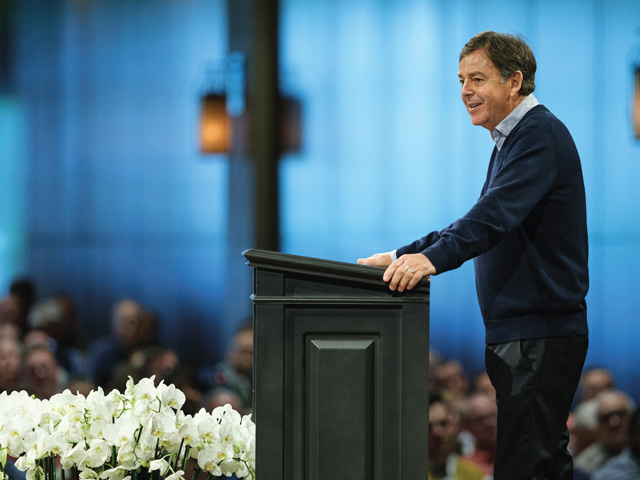
 Becoming a Christian means more than simply adding Jesus to your life by attending church, joining a Bible study, or helping out in ministry. On Truth For Life, Alistair Begg shows us that following Christ involves radical change in how we live and think.
-----------------------------------------
• Click here and look for "FROM THE SERMON" to stream or read the full message.
• This program is part of the series A Study in 1 Thessalonians, Volume 2’
• Learn more about our current resource, request your copy with a donation of any amount.
• FREE AUDIOBOOK! In our polarized culture, disagreement is often seen as combative and offensive. What if there were a way to do it well? Download your free copy of The Art of Disagreeing by Gavin Ortlund and master how to disagree with kindness and influence. Request yours at ‘truthforlife.org/disagree.’
Helpful Resources
- Learn about God's salvation plan
- Read our most recent articles
- Subscribe to our daily devotional
Follow Us
YouTube | Instagram | Facebook | X
This listener-funded program features the clear, relevant Bible teaching of Alistair Begg. Today’s program and nearly 3,000 messages can be streamed and shared for free at tfl.org thanks to the generous giving from monthly donors called Truthpartners. Learn more about this Gospel-sharing team or become one today. Thanks for listening to Truth For Life!
Guest (Male): Becoming a Christian means more than simply adding Jesus to your life and then attending church regularly, or joining a Bible study, or helping out at VBS. Today on Truth For Life, Alistair Begg shows us how following Christ involves radical change in what we believe and how we behave.
Alistair Begg: I invite you to take your Bibles and turn with me to 1 Thessalonians and chapter 4. Brothers, we do not want you to be ignorant about those who fall asleep or to grieve like the rest of men who have no hope. We believe that Jesus died and rose again, and so we believe that God will bring with Jesus those who have fallen asleep in Him. According to the Lord's own word, we tell you that we who are alive, who are left until the coming of the Lord, will certainly not precede those who have fallen asleep. For the Lord Himself will come down from heaven with a loud command, with the voice of the archangel, and with the trumpet call of God, and the dead in Christ will rise first. After that, we who are still alive and are left will be caught up together with them in the clouds to meet the Lord in the air. And so we will be with the Lord forever. Therefore, encourage each other with these words. Father, we pray that with our Bibles open upon our laps, that You will do for us what we so desperately need, and that is to take the voice of a mere man and the desires for cohesive thought and breathe upon them by Your Spirit. So the voice that we hear is the very voice of God through the written word of God, and that in hearing we might understand, and in understanding we may obey. To this end, we seek You in prayer in Jesus' name. Amen. If you would care to turn to one other portion of scripture, Acts chapter 17, I want to take a moment to set in context the eventual direction of this message. It may be that the setting in context will almost become the message, in which case we know what we have to look forward to or be concerned about. But I want you to turn to Acts 17 because it is in Acts 17 that we have the biblical record of the founding of the church in Thessalonica. Paul and his companions had gone through Amphipolis and Apollonia, and they came to Thessalonica. On three successive Sabbaths, Paul took it upon himself, under the guidance of the Spirit of God, to reason in the synagogue from the scriptures concerning the issues with which the members of the synagogue would be very familiar. His message centered on the issue of the Messiah. Of course, there has never been a Jewish boy or girl born who has not lived with the notion of the Messiah, the question of his identity, the time of his coming, and so on. The prophetic passages of the Old Testament were all pointing forward to the Messiah. Some, like Paul prior to his conversion, had lived with the idea that the Messiah was only going to be a dramatic and powerful conqueror. Consequently, when in the person of Jesus Christ there came these claims to Messiahship, those who already had in their minds an expectation which did not include suffering, which did not include meekness, but only involved majesty, they therefore had no place for this Jesus. So Paul, recognizing his challenge, goes into the synagogue and he reasons with them. He explains and he proves that the Christ had to suffer and rise from the dead. That's verse 3. His emphasis was, "You know that there was a Messiah who was to come. Well," he says, "I want to show you that you have been missing the point here in part, and that the Messiah was to be also the suffering servant described in Isaiah's gospel, as well as the great reigning king described in other prophetic passages." He labors to this end to make it clear so that he could bring them to a point of understanding where they would be looking at one another and saying essentially, "You know, that makes sense to me. He doesn't seem to be making anything up. He's quoting from our own scriptures. He's explaining it. We're reading it from the very scrolls that we have, and he is making clear that the Christ had to suffer and also that he had to rise from the dead." Of course, the Pharisees believed in a resurrection at the last day. They were cloudy as to how it would work and the way in which it would unfold. Now comes Paul, who of course had the best of Jewish credentials, and he unfolds for them the scriptures. He says, "Now look, the explanations of the Messiah find their fulfillment in one who would die and rise again." So far, so good. Then comes his punchline in verse 3b: "This Jesus I am proclaiming to you is the Christ." So far they were happy to go along with the progression of thought that the Messiah had to suffer, die, and rise again, but now comes the kicker. "Jesus, whom I'm proclaiming," he says, "is the very Messiah we've just described." At that point, there was an immediate division. Luke tells us that some of the people were persuaded and they joined Paul and Silas, as did a large number of God-fearing Greeks. People who were surrounding the synagogue, they were folks who were interested in religion but couldn't quite put it together. A number of them also believed. We're told that there were a few prominent women who became believers at this time. Paul was in no doubt about what he was doing. Paul was not traveling the country giving religious talks. Who needs another religious talk? Who even likes religious talks? Religious people like religious talks presumably, but even they will weary of just more talk. Paul was not entering into the synagogue simply to pronounce philosophical speculation because that becomes very wearisome. No, Paul had an express purpose. His dramatic change on the Damascus Road had made clear to him that he was now a man with a mission, and his mission was in no way uncertain. He was committed to seeing unbelieving people, whether Jewish or Greek, whatever background, to see unbelieving people become committed followers of Jesus Christ. He wanted them to understand that becoming a Christian is a profound, personal, and permanent change. Becoming a Christian is not as a result of lineage. It's not as a result of being born in the right environment, although that may help. It's not as a result of hanging around church buildings, although hopefully that would at least point us in the right direction. But becoming a Christian is a profound, personal, and permanent encounter with the risen Christ that leaves us in no doubt that what we once were we no longer are and we have been made radically different. When he writes to the Thessalonians now, these years after their beginning of the church, he writes to encourage them to commitment. He writes to make it clear to them what he makes clear in the rest of his letters, that if a person professes to be a Christian, that will be apparent in two particular ways. One, it will be seen in what the individual believes, and two, it will be seen in how they behave. To become a Christian is a mind-altering experience. Anyone who says it isn't doesn't understand what it means to be a Christian. We are not to be afraid of that phrase, although it has negative connotations in certain places. To become a Christian is to change our mind about everything. It is first of all to change our mind about the problems of our lives. Prior to that time, we may think that our problems are environmental. We may think that they're superficial. We may think that they're a result of things that other people have done to us. When we become a Christian, indeed prior to becoming a Christian, we realize that the fundamental problem facing us is the problem of our own rebellion against God, that we have not been doing well in relationship to the Ten Commandments, and they are the expression of God's moral law. So we find ourselves to be in violation of the perfect law that God has established. So we have to change our mind then about our predicament. Until a man or a woman has been brought to the place where they're prepared to change their mind about the predicament that faces them, there is no reason for them ever to embrace Jesus as a Savior. Why ever would you want a Savior if you have nothing from which to be saved? You could have an example, you could have a teacher, you could have a guru, you could have a philosophical leader, but that would be sufficient unless of course you realized that you were a sinner, in which case at that point you and I would need a Savior. You see, when the Bible is proclaimed in its effectiveness, when Paul was proclaiming it to these people, they realized that their change would be first of all in the way they think and in the way they think about the world, in the way they think indeed about everything. It'll change the way you think about your garden. It will change the way you think about the sunrise. It will change the way you think about the birds that sing. It will change the way you think about taking vacations. It will totally change you. If you doubt that, just get a good hymn book and read it. "Birds with gladder songs o'erflow and earth with deeper beauty shine, since I know as now I know, I am His and He is mine." Before then, I used to listen to the bird sing and say that's nice, I wonder where they came from. I used to look at the sky and say what a nice sky, I'm so glad we have it. But now since He became my Father and I became His friend, I say listen to my Father's birds chirping and look at the glory of my Father's handiwork. It changes the way we think about things. We're no longer proud and smug in our own creations. We're no longer drawing attention to our own advancements. We are now bowing down before the wonder of who God is. It is a great change in belief. It is an accompanying great change in behavior, a radical change in behavior. Indeed, if there is no change in behavior, there's no reason to believe that there's been a change in belief. Be very, very careful of somebody who tells you that they've changed their belief system but you don't see it in their behavior. Either they never understood it in the first place or they don't understand it now, but when you change the way you think about things, you will change the way you do things. It is inevitable. You can think about it all kinds of ways. You can think about it, for example, in relation to a golf swing, but we won't get into that. I remember we had a bad time with that last time I was here. We'll just leave that aside. It will change—when you change your thinking, you change your behavior. Now the Thessalonians understood this. 1 Thessalonians chapter 1, verse 8, Paul says to them, "I want to encourage you by letting you know that the message of the Lord is ringing out from you, not only in Macedonia and in Achaia, but your faith in God has become known everywhere. Therefore, we do not need to say anything about it." Just stop there for a moment and think. How did the world know that these Thessalonians were different? They did not know as a result of seeing inside their heads. The change in belief would not become apparent as a result of just sitting opposite somebody on a train. But if—not that I'm suggesting there were trains in Thessalonica—but if we were to sit opposite that individual and find that they behave a different way, then we would inquire as to what the difference in their behavior is. For example, within a few miles of Thessalonica, there was one of the most significant mountains both geographically and religiously in the whole of the then-known world. It was Mount Olympus. Mount Olympus was significant not only for its geographical stature, but it was significant on account of the fact that it was the home of the Greek gods, so believed. So men and women within the framework of Thessalonica would be constantly focusing on Mount Olympus, would be thinking and thanking the gods of Mount Olympus, would be going off for picnics in the hope that the gods would not make it rain on them, and so on. It was part and parcel of their life to be born there, especially if they came from a Greek background, to be riddled with all of that thought concerning religion. Now let's imagine that a couple had come to faith in Jesus Christ. They had heard the word that Paul had preached and they had believed in Him. They were having one of their friends from 100 miles away who were coming over to spend a couple of days with them in Thessalonica. They sent word to say they were going to come, and they said, "By the way, when we come, we're looking forward to our annual picnic on the foothills of Mount Olympus." When the word came to Mr. and Mrs. X concerning the impending visit of their friends and concerning the prospect of the picnic on Mount Olympus, which of course had been something that these two families had been doing all of their lives—they had done it before they had kids, and then they did it when they had kids, and then they did it every time as more kids came along—they were always having picnics on Mount Olympus. But now they came to faith in Jesus Christ. Now Mount Olympus never meant anything to them in terms of the gods. They weren't interested in going back up to the shrines. So they talked to one another. They said, "What are we going to do? They're going to think we're totally weird if we don't go up that hill with them, you know. After all, we've gone there for years." The father says, "Yeah, I know, but since we found this other King called Jesus, since we embraced the lordship and kingship of Christ, we've never paid any attention to Mount Olympus. After all, aren't we supposed to reach our friends and our neighbors? Aren't we supposed to have them come to faith in the same Jesus that we trust?" The father says to the wife, "You know, I think if we go up there for that picnic, we'll be able to cover our bases, but we're going to confuse the issues of Jesus." They must have wrestled back and forth, and eventually the people come into town. "Hey, how are you doing?" "Wonderful, come on in, have a cup of tea," the usual thing, sitting around talking about things. Then of course the question, "So when's the picnic? Same time as usual?" Wife looks at husband, husband looks at wife. Who's the bravest? Wife goes first, as usual. "Well, you know, we were thinking we weren't going to have the picnic this time. At least we're going to have a picnic, but we're not going up on Mount Olympus." "What?" "Well, we've just had another little kid and we haven't ever taken our kid up to the shrine of the god of such and such, and we were looking forward to that." "Yeah, well, we wanted to talk to you about that, about those shrines and gods. We'll get round to it while you're here." "No, no, no, tell me now, what's the deal?" "Well, well we—you see, have you ever heard of Jesus of Nazareth?" And then it would go from there. Now let's cut to the bedroom in the evening when the mother and father who came, the visiting party, came. They're now lying in their beds looking up at the ceiling, making maps with the cracks. They're lying and they're saying to themselves, "Well, here we are, same place as last time, but goodness gracious, there's something really weird going on in here. I mean, can you believe Sadie and George? No picnic. No Mount Olympus. No foreign gods. No shrines." The wife says, "Yeah, did you hear what they were actually saying? You know, they're actually claiming that this Jesus of Nazareth, who's been dead for a while, he's coming back." "Yes," says the husband, "you know, it would be bad enough if all they were saying was we're into Jesus, now let's go for the picnic. It'd be bad enough if they were saying, 'You know, we're interested in the teachings of Jesus, he was a guru and he was a great guy,' that would be bad enough. But they've absolutely gone totally nuts about this. They're saying that Jesus not only died, but he rose from the dead, and not only that he rose from the dead, but he's actually coming back. Oh, let's go to sleep, we'll deal with it in the morning." Now I don't think that's a far-fetched illustration. That's what's supposed to happen now. When a person becomes a Christian, that person is radically changed. For those of us who are brought up in Christian homes and wonder about this and say, "Well, you know, I haven't been living long enough to be like a Hell's Angel and go worshipping in shrines," let me tell you what's happened to you. If God in His grace has reached out to you in your tender life, understand this: you have been saved from a lot of stuff, and it will become increasingly apparent to you the older you get. Some are saved out of a lot of stuff, and if you talk with them, they surely would love to have been saved from it rather than out of it. But whether you were saved from it in prospect or out of it in reality, it is a radical change. I want to say to you that the absence of such teaching has not only led people to spurious professions of faith in Jesus Christ, but confuses the watching world about what it means to believe in Jesus Christ. Because if what we present to people is this: "Listen, all that it means to become a Christian is you just do this belief thing, it's a kind of esoteric thing, you trust Jesus. You can do all the same stuff, it doesn't matter. All you do is you just plug in and then you just go with the flow." There's an awful lot of people who apparently plugged in and are going with the flow, and they don't know who in the world they are, what they are, and nobody knows what to do with them. The difference and the difficulty is that someone never told them, "Listen, new life, new lifestyle." Let me tell you, young people, you commit your life to Jesus Christ, you just signed up for a holy life. You just signed up for a different life. You signed up for a radical change. There must be a change in your behavior. There must be a change that issues from the way you think. Previously you thought about things in a certain way, and now you think differently. The reason you think differently is because the Spirit of God has come to live within your life, and like the people there in Thessalonica, they turned from the lifeless idols to the worship of the living God. Their friends said they no longer worship at those shrines, it's got something to do with Jesus, I haven't had time to ask them. Oh, you say, well that's Thessalonica 2,000 years ago, this is Cleveland. Let me tell you something, Cleveland is full of idols. Contemporary Western culture is full of idols. People have come out of a week of worshipping idols—worshipping money, worshipping power, worshipping fame, work, sport, entertainment, food, alcohol, drugs, sex. There are at least half a dozen magazines dedicated to every idol that is on offer. Just go in Borders bookstore and drown yourself under the magazine racks, and if you look at them, they are the preoccupations of our culture. They are idols. Now if Jesus Christ cannot break the bondage of those idols, then he is less than the person he claimed to be. But in the case of these Thessalonians, he broke the bondage for them. They were once always there, now they're over here, and people said why is that? And they were unashamed. A radical shift had taken place on account of their discovery of the gospel and of the grace of God.
Bob Lepine: You’re listening to Truth For Life with Alistair Begg, and a message titled "Those Who Have Hope." We'll hear the conclusion tomorrow. You know, the Bible assures us that when we ask God to reveal Himself to us, He will. And our prayer is that God will use the teaching of this program to open closed minds so that unbelievers will become committed followers of Jesus. We also pray believers will grow strong in their faith and local churches will be strengthened as a result. Along with our daily program, we love recommending books that will help along these lines. Today, the book we're recommending is called *The Language of Rivers and Stars: How Nature Speaks of the Glories of God*. This book blends theology and poetry together to help you slow down, take time to observe God's power and majesty in the things around us, the things in nature. In the hectic pace of our busy lives, it's really easy to overlook the beauty and the wonder that exists in the surrounding landscapes, in the sky above. This is a book you can sit back and read slowly to help you appreciate God's revelation of Himself in all things that surround us. The book *The Language of Rivers and Stars* is yours for a donation to Truth For Life today. You can give online at truthforlife.org/donate. Or better yet, make today the day you partner with us. Become one of our Truth Partners. These are faithful ministry listeners who give to Truth For Life each month, providing the ministry with the operating income we need to produce and distribute this daily program all around the world. So if you have benefited from the Bible teaching you hear on Truth For Life and would like to join this essential team, sign up today at truthforlife.org/truthpartner or call us at 888-588-7884. And again, when you do, remember to request your copy of *The Language of Rivers and Stars*. It's one of the ways we will say thank you for your support. I'm Bob Lepine. We are learning that when we live to please God, people notice. Tomorrow we'll consider how we can point others to Jesus, even by the way we grieve. The Bible teaching of Alistair Begg is furnished by Truth For Life, where the learning is for living.
Related Episodes
Those Who Have Hope (Part 2 of 2)
Friday, August 28
Christians Grieve Too! (Part 2 of 2)
Wednesday, August 26
Christians Grieve Too! (Part 1 of 2)
Tuesday, August 25
About Truth For Life
Truth For Life distributes the unique, expositional Bible teaching of Alistair Begg. Studying God’s Word each day, verse by verse, is the hallmark of this ministry. In a desire to share the good news of the Gospel without cost as a barrier, the entire teaching archive is available for free download and resources are available at cost with no markup.
About Alistair Begg
Alistair Begg has been in pastoral ministry since 1975. Following graduation from The London School of Theology, he served eight years in Scotland at both Charlotte Chapel in Edinburgh and Hamilton Baptist Church. In 1983, he became the senior pastor at Parkside Church near Cleveland, Ohio. He has written several books and is heard daily and weekly on the radio program, Truth For Life. The teaching on Truth For Life stems from the week by week Bible teaching at Parkside Church. He and his wife, Susan, were married in 1975 and they have three grown children.Contact Truth For Life with Alistair Begg
Website
http://www.truthforlife.org/?utm_source=oneplace&utm_medium=sitelinks&utm_campaign=home
Mailing Address
Truth For Life
P.O. Box 398000
Cleveland OH 44139
Telephone (Customer Service)
888-588-7884 Domestic
400-543-6800 International
440-543-0522 ( Fax)


