Lessons in Leadership (Part 1 of 3)
Ministries > Truth For Life with Alistair Begg
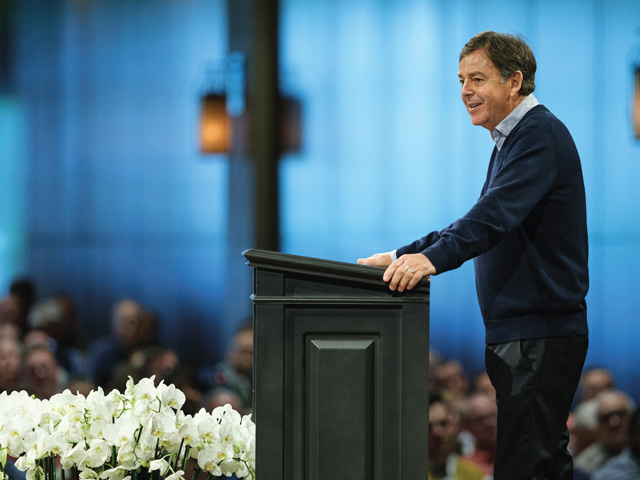
 God calls elders to lead the church and care for the spiritual needs of believers. Some preach God’s Word—but what else does this role entail? And what characteristics should elders exhibit? Think this through with Alistair Begg on Truth For Life.
-----------------------------------------
• Click here and look for "FROM THE SERMON" to stream or read the full message.
• This program is part of the series A Study in 1 Timothy, Volume 2’
• Learn more about our current resource, request your copy with a donation of any amount.
• In one of the most famous sermons ever preached, Jesus explains that the values in His kingdom are vastly different from the world’s values! The poor will be blessed, those who weep shall laugh, and the hungry will be satisfied. What does this mean? Download the free ebook and study guide The Christian Manifesto by Alistair today at ‘truthforlife.org/manifesto’
Helpful Resources
- Learn about God's salvation plan
- Read our most recent articles
- Subscribe to our daily devotional
Follow Us
YouTube | Instagram | Facebook | X
This listener-funded program features the clear, relevant Bible teaching of Alistair Begg. Today’s program and nearly 3,000 messages can be streamed and shared for free at tfl.org thanks to the generous giving from monthly donors called Truthpartners. Learn more about this Gospel-sharing team or become one today. Thanks for listening to Truth For Life!
Guest (Male): God calls elders to lead the church and care for the spiritual needs of believers. Some are responsible for the preaching and teaching of God's word, but what else does this role entail? And what characteristics should we be looking for in our elders? Alistair Begg walks us through the Bible's answers today on Truth For Life.
Alistair Begg: For those of you who are visiting this morning and may wonder why it is that we are dealing with these particular verses, it is because the last time we got as far as the 16th verse of chapter five and we are fulfilling what is essentially a pattern for us in working consecutively verse by verse through various portions of the Bible. Now, it's not always important to point it out, but as will become apparent this morning, since it has to do with money, it's probably a good thing to point out because people will often assume that whenever the question of money is mentioned in the church, that there must be some particular concern about money. And that is often the case when money is mentioned in a church. It's sometimes mentioned with such frequency that people think that's all the place is about, and in other cases, it is only mentioned when there is some kind of crisis. Well, you should know that the only reason there's any mention of it is because Paul is addressing it here in 1 Timothy, and since we're studying 1 Timothy, we come in the course of events to these verses. Now, with the verses before us and our Bibles open on our laps, let's pause and ask for God's help. Gracious God and loving Father, we pray now that You will take my words and speak through them. You will take our minds and help us to think through them. And that You will take our lives and fill them with a passionate desire to live in obedience to the truths that You are teaching us, for Jesus' sake. Amen. Contrary to so much popular opinion, the church is not a democracy. The fact that many churches may try and operate in that fashion does not make them right. The church is neither a dictatorship. And the fact that some churches may operate with a little Pope who rules them does not make it right. There is no place in Scripture that you can go to to either democratize the church or determine that it should be ruled by an individual in terms of a dictatorship. In fact, when we turn to the Bible, we discover that the church is a theocracy, namely that it is God who rules and governs, and He chooses to mediate His rule through the direction of godly men. That God has appointed some to be responsible for the leadership of others, while He has appointed all to be responsible to the leadership of Jesus Christ. And this is not unfamiliar territory to those of us who have been here over a period of time. The English word that is most used to describe the individuals who are involved in this responsibility of ruling the church is elders, and you will find that the word comes almost exclusively in the plural form because there is no suggestion that there is only to be an elder in a church, but rather that this responsibility is to be exercised in plurality and in a biblical form of parity. These elders are to be men of spiritual maturity. The Greek word *presbuteros* is the word which conveys that notion primarily of maturity. They are to be men who exercise a God-given spiritual authority, and the Greek word *episkopos* conveys that. And they are to be exercising this authority in the realm of specific spiritual responsibility. And this specific responsibility is, as we discover in Acts chapter 20 and verse 28, to be shepherds of the church of God. And the Greek word for shepherd is simply the word *poimen*. So these individuals set apart by God, acknowledged by the congregation, are called to act not as the representatives of segments of the congregation, taking up the interests of particular groups within the congregation in the way in which a congressman might represent his district. It's very important to point out because in many churches who are prepared to acknowledge the idea of eldership, they regard the elders as being representatives of little caucuses within the church. So every little group tries to get an elder represented in the hope that this elder will represent their charge and their concern. In point of fact, the representation that the elders bring is the representation of God to the people, not the people to the rest of the elders. The elders are not responsible to the congregation; they are responsible for the congregation. They are responsible as brothers to brothers, as brothers to sisters, as we've seen in Paul's instruction to Timothy as a pastor. He should treat the younger men as brothers, the older men as he would fathers, the older woman as mothers, and the younger women as sisters. And within that framework of relationships, there is all kind of accountability. So it is not that once the elders are appointed to the task of eldership, they are somehow now immune from the one-another dimension of Christian living. It's not that. But it is that in the exercising of their God-given responsibility, they are accountable to God for those under their care. And that, of course, is the most chilling form of accountability that could ever be conceived of. And it is addressed in Hebrews 13:17 where the writer says they keep watch over you, that is the elders do, as men who must give an account. To whom? To God. Now in chapter three, Paul has already addressed the qualifications for serving as an elder in the first seven verses, and he now returns to this particular group to provide further direction for the way in which they function within the church. And the link between what he has said about the widows in verses three to 16 and what he's now about to say concerning elders, I think, is simply this question of honor. The widows were to be given, according to verse three, proper recognition or honor. And the way in which they were to be honored had a direct reference to the providing for their practical needs. Now he is saying that the elders in the church are also to be given proper recognition. They too are to be honored. And it is impossible to think in terms of honoring elders without also entering into this matter of compensation and remuneration. And so in verses 17 and 18, we're going to think for a moment or two about the matter of compensation. And then in verse 19 and verse 20 and 21, we're going to consider the issue of accusation, and then in verse 22, we'll deal with this matter of ordination. So there are just those three words that help me as I go through: compensation, accusation, ordination. I say to myself, "Okay, I know where I am in this passage," and I share that with you in case that might help you around. Of course, if it doesn't, then you can think up three words of your own or 20 words of your own for that matter. But anyway, compensation is the issue here in verses 17 and 18. The elders are those who direct the affairs of the church. That's what they do. They are responsible for the spiritual oversight of the congregation. The King James Version uses the word rule, and they are to rule the church. Now, how do they rule the church? Not on the strength of their personality, not on the basis of peculiar whims that they may have picked up along the journey, but they rule the church by the crook, the shepherd's crook of the word of God. In other words, all of their ability to bring oversight, all of their expressions of pastoral care, all of the matters of teaching are established and governed by this book. And that is why, you see, it is imperative that elders are men of spiritual maturity. And their maturity is directly related to their knowledge of the word of God. Because if you put a man in a position of leadership in the church simply because he was financially successful or was uniquely competent in the realm of business, but is not a man of spiritual maturity, then you will do a disservice both to that individual as well as to the flock under his care. Because when it comes to the issue of ruling, he will immediately revert to business practices or he will revert to the power of his personality. But if he is unfamiliar with the Scriptures, he will not be able to go to the Bible and to say, "This is why we do what we do, and this is why we believe what we believe, and this is why we are going where we are going." It is all wrapped up in this matter of directing the affairs of the church. And it is these individuals we're told who are worthy of double honor. Now this matter of double honor is important, and I think it is simply this, or this is at least a pointer in the right direction: that the double honor is this. They are honored for the role that they fulfill as elders, and then on account of the excellency of their work, they are honored all over again. So there is an honor which attaches to the privilege of eldership, and there is an honor which then attaches to the doing of the work well. Isn't that the distinction there? The elders who direct the affairs of the church well. Now that should be all the elders, but maybe he's making a point there. Maybe he is putting a little barb into the seat of the pants of some who are reading, some who are hearing the letter read: "I wonder, am I one of the ones who directs the affairs of the church well or am I just directing the affairs of the church?" And these who do so well are worthy of double honor, especially those whose work is preaching and is teaching. Now notice that the word work is used. Their work is preaching and teaching. It's customary for people to say of those who labor in the word and in doctrine, "Of course, you don't really work, do you? You don't really have a job. You just read your Bible, pray every day, and grow, grow, grow as it were. But you don't work." Well, the word here, *kopiao*, is a word for toil. And Paul uses it purposefully. It's the word that he uses in 2 Timothy 2 when he uses the various pictures of an athlete and of a farmer. He says it is the hard-working farmer who deserves a share of what he is providing. He should be the first to receive the benefits of his work. And the word there is for toil. And Paul interestingly uses this, whether he is referring to physical or the mental toil that is involved in the responsibility of eldership. 1 Corinthians 15 and in verse 10, he says, "By the grace of God I am what I am, and His grace to me was not without effect. No, I worked harder than all of them." I was a hard worker, he says. And the word there is *kopiao*, I was toiling. When he writes in Galatians and chapter four, he uses the same word in verse 11: "I fear for you that somehow I have wasted my efforts on you." The word there is my toiling. When he writes to the Philippians, he uses the same word in the 16th verse of chapter two: "As you hold out the word of life in order that I may boast on the day of Christ that I did not run or labor"—and the word there is *kopiao*—"I did not labor, work, toil, expend myself for nothing." In other words, he says this responsibility of laboring in the word and in doctrine of directing the affairs of the church, let nobody be in any doubt, this is work. And anyone who engages in the responsibilities of pastoring, of teaching, of being involved as an elder and doesn't break a sweat, or doesn't break their back, or doesn't break their heart, or doesn't keep them awake, or doesn't lift their spirits, or doesn't devastate them, doesn't know what it means to be an elder. The word here conveys the fact that it is both vigorous and it is laborious. And at the end of the day, it has the ultimate examination. Now some of you did your examinations and passed the bar, and it was tough, but it's over. Others of you did your examinations and were entered into a trade, and it's over. Oh, you still work, but you no longer face examinations. You passed the examinations and now you do your work. Here, you do your work and then you face your examinations. You work all of your life and then you get examined. And on that day, you will discover whether your work, your *kopiao*, was wood and hay and stubble or silver and gold and precious stones. Now, I express this with conviction because it comes to me with conviction. All the elders, he says, rule. The directing of the affairs of the church falls to all the elders. All the elders teach, insofar as they are men who, according to what he writes to Titus in Titus 1:9, are men who are apt to teach. I don't think that means that every elder has to be somebody who can stand up and preach in a public fashion. Some teach that; I disagree with them. I don't know if I'm right, but I know that I disagree. Because the phraseology of apt to teach does not necessarily mean the gifting necessary to do so in a public forum. But it does mean that every elder needs to be mature enough in the Scriptures that when a member of the congregation approaches them with a matter of doctrine or with a matter of practice or whatever it is, that the elder is able to go to the Bible and to turn the Scriptures up and to teach from the Bible and to rule and direct the affairs of the church from the book. So in the same way that you would see a shepherd, and you would identify a shepherd as indistinct from other workers in fields and other carers of cattle, you would identify that shepherd by the fact that he would move around with his crook. Then you would be able to identify the elders because they would be moving around with theirs as well because they would want always to be ready to shepherd the congregation, to direct the affairs of the church, and to do so well by means of this vital instruction. Now verse 18 leaves us in no doubt that it is impossible to divorce the notion of honor from remuneration. For the Scripture says, "Do not muzzle the ox while it's treading out the grain." Somebody in hearing verse 17 read maybe say, "Well, what do you mean, worthy of double honor? How should we honor them?" Paul says, "Well, just in case you're missing the point, I'm actually talking about the way in which you provide for them." Now if you turn back to Deuteronomy for a moment—and you should put a marker in Deuteronomy because we'll go back here again a couple more times—but in Deuteronomy chapter 25, God is giving instruction to His people about various practical matters. And it is right in the course of all of this vital practical instruction that He says, "Do not muzzle an ox while it is treading out the grain." It's interesting the way that just drops down there in the midst of all these other instructions. Now in the time of Deuteronomy and the time of 1 Timothy, people would have been very familiar with this picture. A flat, often rocky area, circular many times, a piece of level ground exposed to the wind would become the place in which the grain was brought and laid out symmetrically around in this circle. And then the oxen, often two of them, maybe three of them, would be harnessed to a central point and they would move just laboriously round and round. And as their hooves crunched into the grain that had been cut and they split it apart, then the wind would pick it up and blow it. And as the good stuff would be gathered and set aside for consumption, and the instruction of God is when the oxen are doing that, don't put a muzzle on them. Allow them to eat some of the grain in order that they are well cared for. Now why was God so concerned about oxen? Well, actually He wasn't ultimately concerned about oxen, although He was in passing concerned about oxen. He was concerned about His name and His glory. Because pagans were tempted on account of greediness to put muzzles on the oxen. So they would engage in the same process, but when the poor oxen would try to grab some of this stuff, they couldn't because they had their mouths all jammed up with one of these leather gubbinses. And Paul says, "When the pagan nations see that we don't muzzle the oxen," and they say, "Why don't you muzzle the oxen?" you'll be able to tell them, "Because God is a kind God." The God and Father of Abraham and Isaac and Jacob is a God of kindness. That they might also understand the principle that is conveyed here, that every worker, whether it is an oxen, whether it is a manual worker, or in 1 Timothy 5, whether it is someone who labors in the word and in doctrine, that all of these situations, in every case, the individual or the beast has the right to partake in the fruits of his work. In other words, if God ordained ample provision for oxen that were treading out corn, it is incumbent upon churches to see that those who devote their time and energy to preaching and the teaching of the word are adequately remunerated. That's the principle. He says, "If God is concerned about the oxen, don't you think He's concerned about the pastors?" Now, it's a dreadful shame when congregations conclude that eldership, and particularly the teaching eldership, the responsibility of laboring in the word and in doctrine, that somehow or another congregations conclude that this is not really work. And any notion of honoring them will come when they die.
Guest (Male): You're listening to Alistair Begg on Truth For Life. That message was the first of three parts in a study titled Lessons in Leadership. Alistair will finish part one on tomorrow's program.
Related Episodes
Lessons in Leadership (Part 3 of 3)
Wednesday, October 7
Lessons in Leadership (Part 2 of 3)
Tuesday, October 6
“I Will Rejoice!” (Part 1 of 2)
Saturday, October 3
About Truth For Life
Truth For Life distributes the unique, expositional Bible teaching of Alistair Begg. Studying God’s Word each day, verse by verse, is the hallmark of this ministry. In a desire to share the good news of the Gospel without cost as a barrier, the entire teaching archive is available for free download and resources are available at cost with no markup.
About Alistair Begg
Alistair Begg has been in pastoral ministry since 1975. Following graduation from The London School of Theology, he served eight years in Scotland at both Charlotte Chapel in Edinburgh and Hamilton Baptist Church. In 1983, he became the senior pastor at Parkside Church near Cleveland, Ohio. He has written several books and is heard daily and weekly on the radio program, Truth For Life. The teaching on Truth For Life stems from the week by week Bible teaching at Parkside Church. He and his wife, Susan, were married in 1975 and they have three grown children.Contact Truth For Life with Alistair Begg
Website
http://www.truthforlife.org/?utm_source=oneplace&utm_medium=sitelinks&utm_campaign=home
Mailing Address
Truth For Life
P.O. Box 398000
Cleveland OH 44139
Telephone (Customer Service)
888-588-7884 Domestic
400-543-6800 International
440-543-0522 ( Fax)


