Getting the Picture (Part 2 of 2)
Ministries > Truth For Life with Alistair Begg
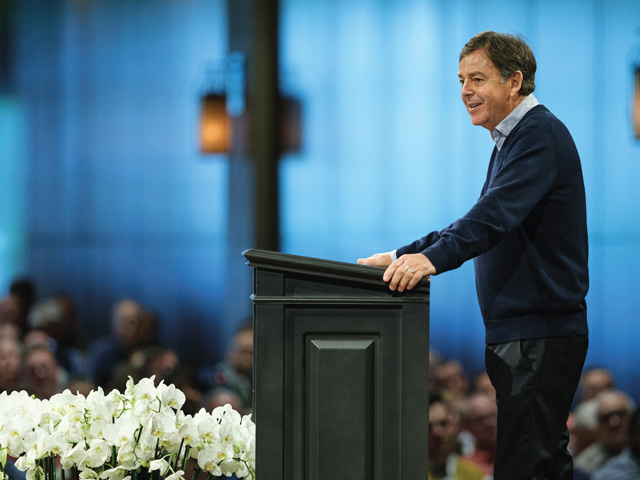
| The main things are the plain things, and the plain things are the main things. This truth guides Alistair Begg’s preaching through the overarching warnings and encouragement found in Daniel’s prophetic dreams. Study along with him on Truth For Life. |
References
Guest (Male): Alistair Begg often says the main things are the plain things, and the plain things are the main things. And today on Truth for Life, this principle guides his teaching through the interpretation of Daniel's prophetic dreams in the Old Testament. We'll hear warnings and encouragement today as we turn to the book of Daniel, chapter seven.
Alistair Begg: The connection between six and seven should be very obvious to us, because you will notice that it begins in the first year of Belshazzar, king of Babylon. In other words, chapter seven, the events of chapter seven took place during the reign of Belshazzar. It did not come subsequent to the events of Darius the Mede. Therefore, what Daniel experienced in his bed on the night happened before the events recorded in chapter five. Because Belshazzar dies in chapter five. So if this happened in the first year of Belshazzar's reign, then we know that the connection between them is very clear. I take it that what we have described in Nebuchadnezzar's statue in chapter two, and what we have here in chapter seven in terms of the four beasts is a description of the same kings and the same empires. Notice my language, "I take it that." That does not mean you have to take it that, or that some of my esteemed colleagues in ministry take it that. But as I read chapter two and as I read chapter seven, it seems fairly straightforward to me that the four kingdoms identified by four metals in the progression of the statue are akin to the four beasts which arise out of the chaos of the sea. So that what we have understood in chapter two, we would then be able to apply in chapter seven. Now, you will notice that this happens when Daniel is lying on his bed. It is in the nighttime. Nighttime heightens, darkens each sensation. He is giving to us the substance of it. Verse one, this is the sum of the matter, and it is clearly significant because he writes it down. It is, if you like, no ordinary dream. Now, let us try and get to it in the time that we have left to us. We will make a beginning at least. I saw in my vision by night, and behold, the four winds of heaven were staring at the great sea. What is that folk song that begins, "Four strong winds that blow lonely, seven seas that run high"? It is a folk song, a folk song. There are obviously more than four winds, but it is customary for people to talk about the winds in this way, North, South, East, and West, covering all of the directions. And these winds, he said, were the four winds of heaven, of heaven. I say, "Well, of course, we think of wind, we think of heaven." But I think there is maybe just a little hint here of what he has been making clear from the very beginning of the book. Remember the very beginning of the book, you can look at it a couple of pages. It will show it to you. He starts the book by reminding us that in the third year of the reign of Jehoiakim, Nebuchadnezzar, the king of Babylon, came to Jerusalem and besieged it. And then here is the point, verse verse two, "And the Lord gave Jehoiakim, king of Judah, into his hand. The Lord gave Jehoiakim, king of Judah, into his hand." In other words, God was sovereignly overruling the triumph of Babylon over Judah, that God was sovereignly in control of the exile of his own people. That, if you like, as the winds blow from heaven over this great sea, which I take simply to be an indication of the reality of humanity in all of its chaos and all of its disorder. You say, "Well, where do you get that from?" Well, just from reading the Bible. For example, you know in the Bible it speaks of how the wicked are like the tossing of the sea. The Babylonian story of the sea is a monstrous place, is a scary place, and they had their own monsters that came up out of the sea, and so on. And the sea in all of its churning and movement and all of its chaos and all of its disorder is representative of sinful humanity. The wicked are like the tossing of the sea. Now, the wind blows from heaven, and as a result of the wind blowing from heaven, the control of heaven is over the emerging of the beasts out of out of this mess. You see, because one of the great things, remember, when when Jesus steps forward amongst the people and particularly amongst his followers, and and they get all really, really worried on the Sea of Galilee. And he stands up and stills the sea, and they say, "What manner of man is this that even the winds and the waves obey him?" God is sovereign over the tides and over the oceans. The four winds blew, and as a result of the blowing of the winds of heaven, four great beasts came up out of the sea. So we are not to think of God going, "Oh, wow, where do these beasts come from? What in the world is happening now? Dear, oh dear, my world that I have made, look what is happening. Where are all these kingdoms coming from? What am I going to do?" No, no, no, no. We need to remember that when we are thinking about ISIS, when we are thinking about Pakistan, when we are thinking about Syria, when we are thinking about North Korea, when we are thinking about all of these things, the same God who is sovereign over these affairs is sovereign over the kingdoms and empires of our world this morning. I wonder, do you believe that? Now, these four great beasts that came up out of the sea were different from one another. We need not be in any doubt about the fact that they represent kings or kingdoms, because verse 17 tells us that they do. "These four great beasts are four kings who shall arise out of the earth." Now, if we are correct in tying the vision in chapter two with that in chapter seven, we can safely assume that we are dealing with the same empires. We identified them as the Babylonian, the Medo-Persian, the Greek, and the Roman. Now again, not everybody agrees with this. Some people think that it ends up with the Greek Empire. Some people think that you are not to tie it to any empires at all, that it is simply a symbolic reference to the movements of humanity over time, a bit like the the times of difficulty and the seasons of animosity that Paul mentions when he writes to Timothy in the first century in in chapter two and chapter three. Be that as it may, we are starting from the perspective that just in the same way as we recognize that beasts are often used as identifying symbols of a nation. For example, Russia and the bear, uh, Scotland and a rampant lion, America and an eagle. Incidentally, we should be thankful that Benjamin Franklin did not get his way, right? Otherwise, we would have a turkey rather than an eagle. It is good that he was overruled on that. I do not even want to think about that for now. But anyway, here we go. So these beasts are identifiable as elements of of kingdoms. First of all, we will just go through them very quickly because we will have to come back to this in any cases. It is impossible not to. First of all, one like a lion that had eagle's wings. Its wings were plucked off. It was lifted up from the ground. It was made to stand on two feet like a man, and the mind of man was given to it. Now, what have we already said? We have said that these represent these different empires. When you read in Jeremiah, you discover that one individual is identified at certain points as a lion and at other points as an eagle. Who is that person? Nebuchadnezzar. Nebuchadnezzar is identified in that way. And so I take it that what we have here is a description of this Babylonian Empire. The lion is the powerful, most powerful and formidable of the beasts on the ground. The eagle is the great, the great sovereign of all the birds. But in this dream, the the uh, the wings are plucked off. Well, Nebuchadnezzar had his wings plucked off, did he not? Sure did. It is a picture. It is a metaphor. He thought he could flap around anywhere he wanted to, and he ended up crawling around in the ground until God stood him up on his feet and renewed his mind and renewed his heart. Vision number one. The vision fades only to be replaced by another. This eagle and lion. Incidentally, I should say in passing that Babylon had this as a symbol on many of its gates. That was a lion with wings. So Daniel would have been familiar with this when he moved around the city. You often say to yourself in your dreams, "How come I thought about that? How did I dream about that? Where did that come from?" We cannot usually be right, but it is no surprise to realize that he sees the embodiment of this, if you like, the thing that is the symbol of the power of Babylon, is there in his mind as this monstrous creature and the triumph of God over it. The bear. I just noted Calvin, who says, "We know a bear to be a mean and foul animal, slothful and inert as well as cruel." Well, I must go to the must go to the zoo with Calvin sometime. He has got such a love, let us go see the bears, John. For those of you who are bear lovers, I do like teddy bears, but this is presumably a Syrian bear, which could be as much as 550 pounds. A real brute of a thing, horrible thing, scary in the night, I would think. Whoa! And it was raised up on one side. Medo-Persian Empire. One side was stronger than the other. Is that the indication? I do not know. It had three ribs in its mouth. Oh, I wonder what the three ribs are. Spend the afternoon figuring it out. Do not send me a note. I think it is, I think it is straightforward. It was his lunch, for goodness sake. He had a voracious appetite. He devoured people, he devoured things. And when you looked at him in the same way that you could see somebody who said, "You have been you have been eating again, have you?" "No." Open your mouth and you can see the elements of it right there. The three ribs are there. He had three ribs in his mouth between his teeth. "You have got something between your teeth!" And there he showed it. And he had done what he had done as a result of a word from outside of him, "Arise and devour much flesh." I want you to notice that in the first three beasts the verbs are all passive. They are passive. They are operating in response to. Thirdly, quickly, and after this I looked, and behold another like a leopard with four wings of a bird on its back, and the beast had four heads. Wow! This is scary too. The leopard, swift, dangerous, you ever see National Geographic on TV? And and it had wings as well to speed, presumably and enable its progress, and it had four heads. Presumably, giving it the ability to look in all directions simultaneously. Unless, of course, it had four heads, all looking in the same direction. Which you could have, I suppose, but it does not seem likely to me. What would you want four heads for, all looking in the same direction? But anyway, this is this is it. Where are we now? We are in the Greek Empire. Who was the head of the Greek Empire? Alexander the Great. Did Alexander the Great move swiftly to destroy the Medo-Persian Empire? Yes, he did. Did he move powerfully? Yes, he did. History records that with 30,000 troops, he took on the power of the Medo-Persian Empire in a number of battles. One time, 150,000 went against his army. Another time, 400,000 went against his army. Another time, 800,000 went against his army. He defeated them all. He controlled the entire region within 10 years by the age of 32. And the world looked on and said, "How in the world can this young fellow do this and destroy such a vast empire?" The answer is right here if my assessment is correct. And the beast had four heads, and dominion was given to it. Given to it by whom? Given to it by God. How do you explain the British Empire? Dominion was given to it and taken from it. How do you explain the rise of the Soviet Empire? Dominion was given to it. How do you explain Korea? The same way. Do you see what we are supposed to get from this is not a kind of crazy preoccupation with trying to fit all the bits together like some gigantic cosmic jigsaw puzzle or Rubik's Cube, but to stand far enough back from the picture to say, "Oh, I get it." Because now in the fourth beast, there is no point of resemblance to any creature on earth. Notice that. It is as though the thing has got so amazing that there is not a creature that can be used to describe the terrifying and dreadful nature of this beast. It had iron teeth. It devoured, it broke in pieces, it stamped what was left with its feet. It was different from all the beasts that were before it. So here we are, at the Roman Empire. Remember when we did chapter two, we said, "And it was in the time of this empire that one would arise like unto the Son of Man." Now, if you have read anything of church history, you know that the Roman Empire managed to go from sea to shining sea and beyond. I said to you before, that they came to Britain. They did well in Britain. Julius Caesar did well in Britain. They did not manage to take Scotland, but they did pretty well down in they did pretty well down in England. And the brutality and the terrifying nature of the advance of Rome is recorded here in this visionary picture. And it had 10 horns. Here we go. I grew up, as soon as there were 10 members in the European Common Market, I was good on chapter seven. Here we go. The 10 horns, the Roman Empire. The Roman Empire is still around. They moved it to Brussels. 10 countries have got it clear as a bell. Then there were 11 countries. Maybe the little horn, maybe not. Then 12, then 14, then 15. Then I thought, maybe not. I do not think so. How many horns do you usually have on your head? A beast. Two. This is five times two. That is 10. I figured that out. In other words, this is really, really, really powerful. Yeah, but what are we going to do with the little one? The little horn. Well, actually Daniel does not know what to do with the little horn, and he isolates it on, which means we will deal with it later on. But the fact is that the the progression here in this vision of the night is increasingly daunting. The picture seems to be that these pernicious creatures are increasingly bold in their activity and in assuming their independence from the source of all dominion and power. So the little horn, if you like, is essentially evil personified. That when you take the embodiment and give it eyes, intelligence, and a voice, and a strutting stare, in all that is in opposition to God, you realize why it is that when you read in the New Testament as Paul speaks about the spirit of lawlessness that is present. As John anticipates the presence of the Antichrist. Although the spirit of Antichrist, he says, is already in the world. You begin to realize that in the midst of all of this chaos, in the midst of all of this opposition, in the midst of all of this order, faced by this mouth, speaking great things in opposition to God. Boy, do we need some kind of intervention. You can imagine Daniel getting up and having a drink of water, and then and and going back to his bed, and then verse nine, "And as I looked, thrones were placed." Oh, he says, "This is a little better." "And the Ancient of Days took his seat." God, who, if you like, in the first eight verses here, has been at work behind the scenes, steps forward and sits in his rightful place of authority. To this we will return. And in these night visions, he saw one who came with the clouds of heaven like a son of man. And he came to the Ancient of Days, was presented before him. And to him was given dominion and glory and a kingdom. Well, of course, we are at Jesus, are we not? Jesus stands up and he says, "The time is fulfilled. The kingdom of God is at hand. Repent and believe the good news." "I am the king. I have come to establish a kingdom. I invite you to bow down under my rule and my reign." You see, loved ones, it is really impossible to go through material like this and even think about a king who comes to reign and the cosmic rulership of God, and his intervention in the affairs of history and his final triumph over all, and go through all of that and tick all the boxes and yet walk out and go lie down on your own bed and Christ does not reign as king on the throne of your heart. He does not reign as king on the throne of your heart. And you could be as intrigued as a niche person about what this means. You could write stories about it, books on it, describe it to many people, as many can. But the real issue is, this king who comes to reign, comes first to rule and reign in me. To subdue my rebellion, to forgive my sin, to fill my broken life with his greatness and his wonder. To allow me to read my newspaper, to face the coming elections, to discover the inhumanity that is represented in the injustice of our world, and to stand far enough back from it and say, "You can raise up any empire you want, and you can raise any little horn that you want, and you can be the embodiment of evil in all of its fullness." But here there is one like unto the Son of Man, and he will reign forever and forever. The only way you will come to this is by grace through faith. Even as I speak to you now, I see my own television screen. I see my own newspapers. I see the headlines, and I hear my voice saying, "Lord Jesus Christ, you are sovereign over all these affairs." And I find myself saying, "And how did you come to this conclusion, Alistair?" How did I? How did I? Because a Sunday school teacher, when I was six years old, told me who Jesus was, told me why Jesus came, urged me as a little sinful Scottish boy to trust Jesus, which I did. How about you? Well, we will come back, unless we decide not to. A very short series on Daniel seven. Lord, Lord, come and reign in us. Come and reign in our hearts individually. Come and reign in our church family. Lord, we need all of our rebellion subdued. We do so desperately require the invasion of your power and majesty in heart and in home, in church, in school, and in government. Oh, look upon us in your mercy, Lord, we pray. For we humbly ask it in the name of your son, Jesus. Amen.
Guest (Male): You are listening to Truth for Life with Alistair Begg. As Alistair mentioned, learning about apocalyptic prophecy can be frightening if Jesus does not first rule and reign in you. And that is why our mission at Truth for Life is to teach the Bible with clarity and relevance so that unbelievers will come to know Jesus as Lord and Savior. And so believers can continue to grow in their faith. We consider it a privilege to teach God's word to millions of listeners all around the world. If you have partnered with us prayerfully or financially, your support is what makes this global outreach possible. We are grateful for your faithfulness as together we celebrate the work God is doing through Truth for Life. If you benefit from the teaching you hear on Truth for Life, will you reach out to us with your support by giving a donation? You can do that by calling us at 888-588-7884. You can also give securely online at truthforlife.org/donate. Any gift you give, large or small, helps bring the gospel to people all around the world. And when you make a donation today, we want to say thank you by inviting you to request the books we recommend, and today we are actually featuring a two-book bundle that will help you dive deeper into who Jesus is and all he has done and continues to do in our lives. The books are titled Christ and His Threefold Office and Christ Humbled, Yet Exalted. These are revised versions of a classic Puritan work called The Fountain of Life. Both books are yours for a donation to Truth for Life. Thanks for listening. When you hear about the increasing hostility against Christianity, do you worry that the church is in danger of being destroyed? If so, join us tomorrow for a much-needed reminder. The Bible teaching of Alistair Begg is furnished by Truth for Life, where the learning is for living.
Related Episodes
Getting the Picture (Part 1 of 2)
Monday, July 20
“Why Don’t You Ask Him?”
Saturday, July 18
Ropes and Rags (Part 2 of 2)
Friday, July 17
About Truth For Life
Truth For Life distributes the unique, expositional Bible teaching of Alistair Begg. Studying God’s Word each day, verse by verse, is the hallmark of this ministry. In a desire to share the good news of the Gospel without cost as a barrier, the entire teaching archive is available for free download and resources are available at cost with no markup.
About Alistair Begg
Alistair Begg has been in pastoral ministry since 1975. Following graduation from The London School of Theology, he served eight years in Scotland at both Charlotte Chapel in Edinburgh and Hamilton Baptist Church. In 1983, he became the senior pastor at Parkside Church near Cleveland, Ohio. He has written several books and is heard daily and weekly on the radio program, Truth For Life. The teaching on Truth For Life stems from the week by week Bible teaching at Parkside Church. He and his wife, Susan, were married in 1975 and they have three grown children.Contact Truth For Life with Alistair Begg
Website
http://www.truthforlife.org/?utm_source=oneplace&utm_medium=sitelinks&utm_campaign=home
Mailing Address
Truth For Life
P.O. Box 398000
Cleveland OH 44139
Telephone (Customer Service)
888-588-7884 Domestic
400-543-6800 International
440-543-0522 ( Fax)


